
Every professional development decision comes with a cost-benefit question attached, and NEBOSH Courses are no exception. For individuals and employers across Saudi Arabia weighing up the investment, the return often turns out to be far higher than expected.
For an individual professional, the upfront cost of a NEBOSH Certificate is typically recovered many times over through improved job prospects and higher salary bands. Safety officers holding this qualification frequently report being shortlisted for roles that were previously out of reach, particularly in construction and oil and gas companies operating across the Kingdom.
Part of calculating ROI accurately means understanding the full NEBOSH course requirements upfront — including study materials, exam fees, and any resit costs. Fortunately, the NEBOSH course requirements for entry-level qualifications remain accessible, meaning most professionals can budget for the full process without unexpected financial surprises along the way.
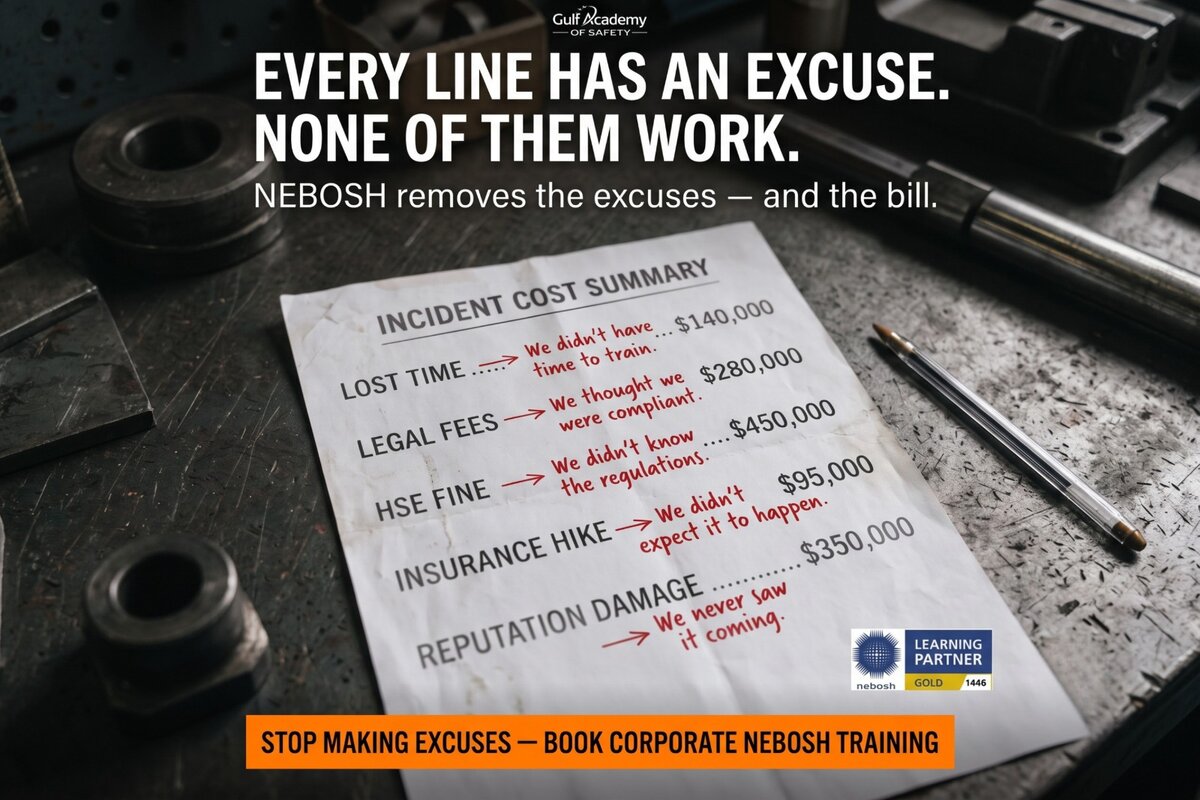
From a company standpoint, the return on investing in NEBOSH Training for staff often shows up indirectly — through fewer lost-time injuries, reduced insurance premiums, and lower regulatory penalties. In high-risk sectors like construction and petrochemicals, a single prevented incident can offset the entire cost of training an entire department.
Naturally, the cost of NEBOSH Courses varies between providers, but price shouldn't be the only factor considered. A slightly higher upfront investment with a proven NEBOSH Gold Learning Partner often delivers better exam pass rates, meaning fewer wasted resit fees down the line. When calculating true ROI, factor in the likelihood of passing first time, not just the sticker price.
Unlike some short courses that lose relevance quickly, the knowledge gained from NEBOSH Courses tends to compound over a career. Professionals often use their initial Certificate as a springboard toward Diploma-level study years later, effectively building on their original investment rather than starting from scratch.
Providers offering genuinely strong NEBOSH Training — with experienced tutors, practical case studies, and proper exam preparation — tend to produce graduates who apply their knowledge more effectively on-site. This translates into fewer near-misses and safer working conditions, benefits that are difficult to put a precise number on but are keenly felt by operations teams.
When weighed against other forms of professional development — generic leadership seminars, short unaccredited workshops, or informal on-the-job coaching alone — structured, internationally recognised safety education tends to offer a clearer, more measurable return. Unlike softer development options that are harder to quantify, a recognised qualification produces a tangible credential that can be verified, referenced in job applications, and built upon through further study, making the investment easier to justify and track over time compared to less formal alternatives.
To put ROI in concrete terms, consider a typical scenario: an individual invests a moderate sum in tuition, study materials, and exam fees. Within the following year, they move into a supervisory or advisory safety role carrying a meaningfully higher salary than their previous position. Over a multi-year career, that single upfront investment continues paying dividends through every subsequent promotion or job change, since the qualification remains on their CV permanently rather than needing to be repeated. Employers, meanwhile, often find that the cost of training an entire safety team is dwarfed by the cost of even one serious incident involving equipment damage, project delays, or regulatory fines.
Not every benefit shows up neatly on a spreadsheet. Employees who complete structured safety education frequently report greater confidence in their day-to-day decision-making, since they're no longer relying purely on instinct or informal on-the-job tips passed down from colleagues. Employers, in turn, often notice improved morale among site teams once workers feel their safety concerns are being taken seriously by properly trained supervisors. These softer returns — confidence, morale, trust — rarely appear in a formal ROI calculation, but they contribute meaningfully to a healthier, more productive workplace overall.
Is it worth paying more for a highly-rated provider versus the cheapest option available? In most cases, yes — a strong pass rate on the first attempt often ends up cheaper overall than a lower initial fee followed by resit costs. Do employers typically cover training costs, or is it usually self-funded? This varies widely; some companies sponsor staff fully, others offer partial support, and many professionals invest independently as a personal career decision. How long does it typically take to see a return on this investment? Many professionals report tangible career movement within six to twelve months of completing their qualification.
Cost concerns shouldn't automatically rule out pursuing this kind of qualification. Many employers across Saudi Arabia offer full or partial sponsorship for staff pursuing recognised safety training, particularly for employees already in safety-adjacent roles. Some training providers also offer instalment payment plans, spreading the cost over several months rather than requiring a single upfront payment. Before assuming a qualification is financially out of reach, it's worth having a direct conversation with your employer's HR or training department, or asking providers directly about flexible payment arrangements they may offer.
For individuals genuinely curious about their own return on investment, it helps to track concrete milestones after completing training — new responsibilities taken on, salary changes at review time, or new job opportunities that specifically referenced the qualification during the interview process. Keeping a simple record of these outcomes not only satisfies personal curiosity but also provides concrete talking points for future negotiations, whether that's requesting a raise, applying for a more senior role, or building a case for employer-sponsored advanced study down the line.
Whether you're an individual planning your next career move or an HR manager building a training budget, the numbers consistently favour investing properly in recognised safety qualifications rather than cutting corners.
Like most meaningful investments, the full return on a safety qualification doesn't always show up immediately. Some professionals see career movement within months, while others find the benefits accumulate more gradually, showing up first in day-to-day confidence and competence before eventually translating into a formal promotion or new opportunity. Approaching the decision with realistic patience, rather than expecting instant results, tends to lead to a more satisfied, less frustrated experience overall.
Beyond the direct fees involved, it's worth briefly considering the opportunity cost of the time spent studying — hours that might otherwise go toward other pursuits. Most professionals find this trade-off easily justified once they weigh it against the career and safety benefits gained, particularly since flexible study formats mean the time commitment rarely requires sacrificing existing work responsibilities or significant personal time, unlike some older, purely classroom-based models of professional education.
The point in your career at which you pursue this kind of qualification can influence the size of the return you eventually see. Early-career professionals often benefit from a longer runway to apply and build upon the knowledge gained, compounding its value across decades of work. Mid-career professionals, meanwhile, often see faster, more immediate returns, since they can apply new frameworks directly to existing responsibilities and use the qualification to support an imminent promotion case. Neither timing is wrong, but understanding where you sit in your own career trajectory can help set realistic expectations for how quickly you'll see a measurable return on the investment.
It's worth repeating that the provider you choose has a direct bearing on your eventual ROI. Studying through a genuine NEBOSH Gold Learning Partner tends to produce stronger first-attempt pass rates, meaning you avoid the extra cost and delay of resits. Likewise, earning your NEBOSH Certificate through a provider known for practical, well-structured teaching means you're more likely to actually apply what you've learned effectively on site, compounding the value of your investment well beyond the exam itself. Cheaper, lower-quality alternatives may look attractive upfront but often cost more in the long run through repeated attempts or weaker practical outcomes.
Whether you're calculating personal career ROI or building a company-wide training budget, the underlying logic remains consistent: quality training, delivered by a reputable provider, tends to pay for itself many times over through improved safety outcomes, stronger career progression, and reduced incident-related costs. The upfront investment might feel significant in isolation, but viewed across an entire career or an entire company's operational history, it consistently ranks among the more cost-effective decisions available to both individuals and organisations operating in Saudi Arabia's high-risk industries.
Ready to see the return for yourself? Enroll in NEBOSH courses today and start building long-term career and business value.

This post has been authored and published by one of our premium contributors, who are experts in their fields. They bring high-quality, well-researched content that adds significant value to our platform.











Plumbing Guide provides practical plumbing tips, helpful guides, maintenance advice, and easy-to-understand information for homeowners and DIY enthusiasts.